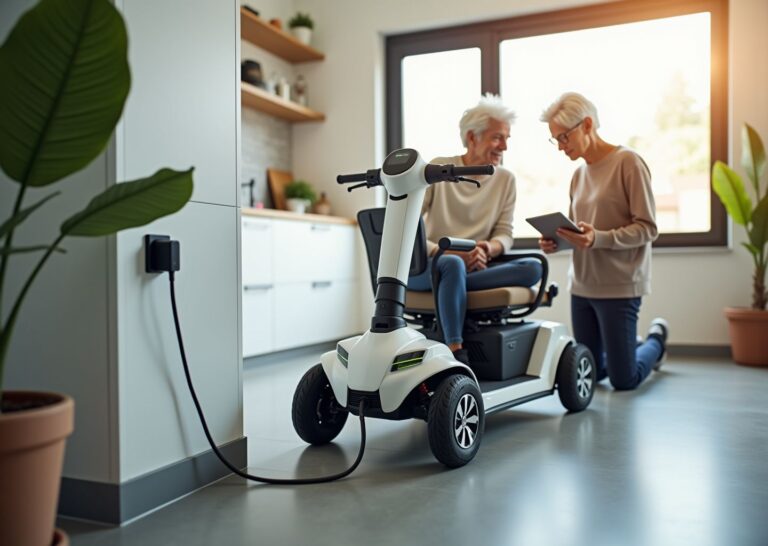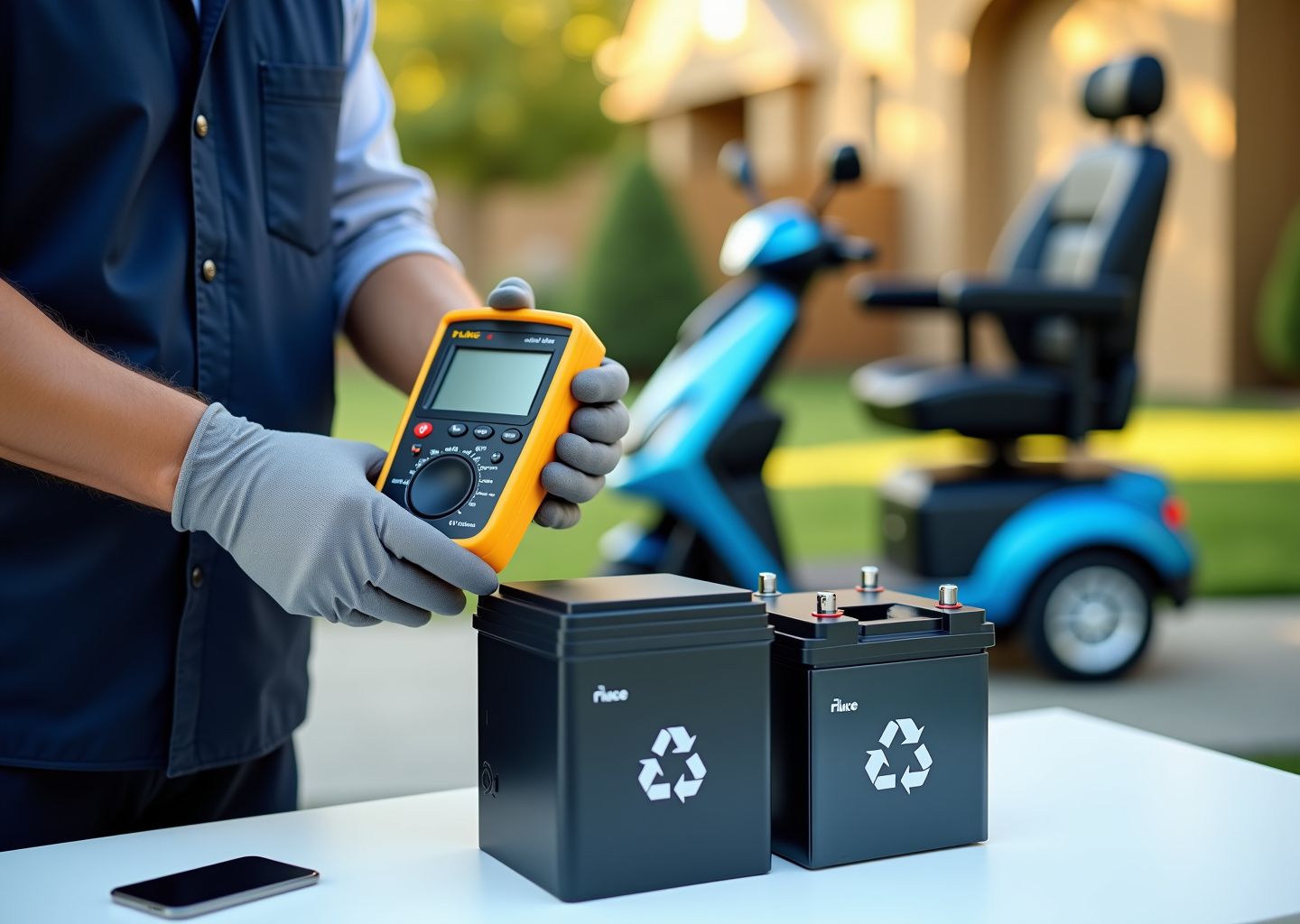
Batteries are the heart of every mobility scooter — they determine range, reliability, safety, and running costs. This guide walks U.S. riders and caregivers through battery types, selection criteria, charging best practices, maintenance checklists, troubleshooting, replacement, and proper recycling so you can get the most life and safest operation from your scooter.
Why Mobility Scooter Batteries Matter
Your mobility scooter is a finely tuned machine, but its performance hinges on the battery. Think of it as the heart of your scooter; without a healthy, reliable power source, the most advanced motor or comfortable seat is useless. The battery’s condition directly dictates your freedom, safety, and finances. Understanding why it matters is the first step toward smart ownership.
The performance of your scooter is directly tied to two key battery specifications: Voltage (V) and Amp-hour (Ah) capacity. Voltage is the raw power your motor has. Most mobility scooters in the United States use a 24-volt system, typically achieved by linking two 12-volt batteries in series. This voltage provides the necessary force for the motor to handle everyday tasks, from accelerating smoothly on a flat sidewalk to climbing a ramp. A battery that can’t maintain its voltage under load will make your scooter feel sluggish and struggle with inclines.
Amp-hour capacity, on the other hand, is the fuel tank. It measures how much energy the battery can store and determines your scooter’s maximum range. A 35Ah battery can deliver more energy over time than a 12Ah battery, letting you travel farther on a single charge. When a battery ages, its effective capacity shrinks, turning your reliable 15-mile scooter into one that might only manage 8 miles, forcing you to plan shorter trips and recharge more frequently.
Battery health has profound real-world consequences. The most common issue is range anxiety—the constant fear of your scooter dying far from home. This isn’t just an inconvenience; it can be a serious safety issue, potentially leaving you stranded in an unsafe location or bad weather. An aging battery is the primary cause. For example, a two-year-old Sealed Lead Acid (SLA) battery originally rated for 35Ah might now only hold a 20Ah charge. This nearly 43% reduction in range means a trip to the pharmacy and grocery store, once easily done on one charge, now requires a mid-day recharge or becomes two separate trips.
Unexpected failures are another significant risk. A neglected battery can fail suddenly, especially under stress, like when climbing a hill. This isn’t a slow decline; it’s a complete shutdown. This risk is magnified by poor maintenance, such as letting terminals corrode or failing to keep the battery properly charged. These issues can lead to a scooter that won’t start at all, leaving you completely immobile.
The physical characteristics of the battery, like its weight and placement, are also engineered for safety. Traditional lead-acid batteries are heavy, and scooter designers use this weight to their advantage, placing them low in the frame to create a stable center of gravity. This improves balance and handling, making the scooter less likely to tip. When considering an upgrade to a much lighter lithium battery, it’s important to understand how this weight reduction might alter the scooter’s handling characteristics.
Your financial investment is also at stake. A worn-out battery doesn’t just reduce range; it increases your total cost of ownership. If your battery has lost half its capacity, you must charge it twice as often to cover the same distance. This not only increases your electricity costs but also accelerates the battery’s decline, as most have a finite number of charge cycles. You’ll find yourself buying replacement batteries far more frequently, turning a manageable maintenance cost into a significant recurring expense.
Finally, your local environment and riding habits are critical factors. Battery performance is not universal across the United States.
- Climate Impact: In colder climates like the Northeast or Midwest, winter temperatures can slash the effective capacity of a lead-acid battery by 20% to 30%. A scooter that gets 12 miles in the summer might only get 8 or 9 miles in freezing cold. Riders in hot climates like the Southwest face a different challenge; high temperatures accelerate battery degradation, shortening its overall lifespan.
- Usage Patterns: A daily rider who relies on their scooter for all errands needs a durable, high-capacity battery that can withstand frequent use. A long-lasting lithium or high-cycle Gel battery might be a smarter long-term investment. For an occasional rider who only uses their scooter for short, infrequent trips, a standard and more affordable Sealed Lead Acid battery may be perfectly adequate.
Matching your battery choice and care routine to your lifestyle and geographic location is essential. It ensures your scooter remains a reliable tool for independence, not a source of stress and unexpected costs. The health of your battery is the health of your mobility.
Common Battery Types Used in Mobility Scooters
The battery is your scooter’s engine, and just like car engines, they aren’t all built the same. Understanding the different types is the first step to making a smart choice that fits your lifestyle and budget. Most scooters in the US run on a 24-volt system, typically created by linking two 12-volt batteries together. While the voltage is often standard, the chemistry inside those batteries makes all the difference in performance, weight, and cost.
The Lead-Acid Family: The Traditional Workhorses
For decades, lead-acid batteries have been the go-to power source for mobility scooters. They are reliable, widely available, and affordable. All modern lead-acid scooter batteries fall under the category of VRLA (Valve Regulated Lead Acid), which means they are sealed and won’t leak acid if tipped over. This makes them safe for transport and use. Within this family, you’ll primarily find two types.
Absorbed Glass Mat (AGM)
AGM is the most common battery type found in budget and midrange mobility scooters. Inside, the battery acid is absorbed into fine fiberglass mats sandwiched between the lead plates. This design makes them spill-proof and highly resistant to vibration, a great feature for daily use on sidewalks and varied terrain.
- Voltage and Capacity: They are almost always 12-volt modules, used in pairs for 24-volt systems. Capacities range from a small 12Ah for portable travel scooters up to 55Ah or more for larger, full-sized models.
- Weight and Lifespan: These are heavy batteries. A pair of 35Ah AGM batteries can add over 45 pounds to your scooter. Their lifespan is typically between 300 to 700 charge cycles, which translates to about 1 to 3 years of regular use, assuming you don’t drain them past 50% regularly.
- Charging and Cost: A full charge takes around 8 to 10 hours. They are the most budget-friendly option, making them an excellent choice for riders who use their scooter occasionally or need an affordable replacement.
- Usage Scenario: Perfect for the standard, everyday scooter where upfront cost is a major factor and weight isn’t a primary concern for transport.
Gel Lead-Acid
Gel batteries are another type of sealed lead-acid battery, but instead of using mats, the electrolyte is mixed with silica to form a thick, putty-like gel. This construction makes them exceptionally durable and even more resistant to deep discharging than their AGM cousins.
- Voltage and Capacity: Like AGM, they are 12-volt batteries used in 24-volt configurations, with similar amp-hour (Ah) ranges.
- Weight and Lifespan: Gel batteries are slightly heavier than AGM batteries of the same size. However, they offer a longer service life, often providing 500 to 1,000 cycles. Their tolerance for deep discharge means they hold up better if you frequently run your scooter until the battery gauge is low.
- Charging and Cost: They require a slightly longer and more specific charging cycle, often taking 10 to 12 hours. They cost a bit more than AGM batteries, but the extended lifespan can justify the price for heavy users.
- Usage Scenario: Best suited for heavy-duty scooters and power wheelchairs, or for riders who depend on their scooter for long-distance, daily travel and may not always be able to recharge before the battery is significantly drained.
The Modern Contender: Lithium-Based Batteries
Lithium batteries have rapidly gained popularity in the mobility world. While the term “lithium-ion” covers many chemistries, the one most trusted for mobility scooters is Lithium Iron Phosphate (LiFePO4). It is prized for its stability and safety compared to other lithium chemistries used in smaller electronics.
Lithium Iron Phosphate (LiFePO4)
This technology represents a major leap forward, offering a powerful combination of low weight, long life, and consistent performance.
- Voltage and Capacity: Available in 12-volt and 24-volt packs, they have a much higher energy density. This means a 20Ah lithium battery can often deliver the same or better range as a 35Ah lead-acid battery.
- Weight and Lifespan: This is their biggest advantage. A lithium battery pack can be less than half the weight of a comparable lead-acid set. This makes a huge difference for travel scooters that need to be lifted into a car. Their cycle life is phenomenal, often rated for 2,000 to 4,000 cycles or more, easily lasting 5 to 10 years. They also tolerate deep discharges well.
- Charging and Cost: They charge very quickly, typically in just 2 to 4 hours. Their discharge curve is also very flat, meaning your scooter will maintain full power until the battery is nearly empty, unlike lead-acid batteries that get sluggish as they drain. The upfront cost is significantly higher, but the long lifespan often makes them cheaper in the long run.
- Safety and Maintenance: LiFePO4 is the safest of the mainstream lithium chemistries, with a very low risk of thermal runaway. They are completely maintenance-free and include a built-in Battery Management System (BMS) that protects them from overcharging, over-discharging, and overheating.
- Usage Scenario: Ideal for portable travel scooters, high-performance models, and daily riders who want the best performance, fastest charging, and lowest long-term cost.
If you plan to fly with your scooter, be aware that the Department of Transportation (DOT) and airlines have strict rules for lithium batteries. They are regulated under standards like UN 38.3, and you must check with your airline well in advance about their specific policies on battery size and transport.
To visualize the trade-offs, consider these factors. For upfront cost, AGM is the lowest, followed by Gel, with Lithium being the highest. For weight, the order is reversed, with Lithium being the lightest by a wide margin. For lifespan, measured in both years and charge cycles, Lithium is the clear winner. Finally, for convenience, Lithium’s fast charging and consistent power output put it far ahead. Your choice depends on which of these factors matters most to you.
Choosing the Right Battery for Your Scooter
Selecting a new battery for your mobility scooter is a critical decision. By breaking it down into a few logical steps, you can confidently choose a power source that fits your scooter, your lifestyle, and your budget.
Step 1: Decode Your Scooter’s Specifications
Before you start shopping, gather essential data from your scooter’s user manual or the label on the old batteries.
- Voltage (V)
This is non-negotiable. Nearly all mobility scooters in the US operate on a 24-volt system, achieved by connecting two 12-volt batteries in series. You must replace them with 12-volt batteries. Using anything else will damage your scooter’s electronics. - Capacity (Ah)
Amp-hours (Ah) measure the battery’s fuel tank. A higher Ah rating means a longer potential range. While you can often upgrade to a slightly higher Ah battery for more mileage, you are limited by the physical space in the battery compartment. A 55Ah battery will not fit where a 35Ah battery used to be. - Physical Dimensions
Measure the length, width, and height of your current batteries. A replacement must fit perfectly into the battery box. An ill-fitting battery can vibrate, leading to damaged connections or internal components. - Terminal Type and Orientation
Look at where the cables connect. Note the terminal style (e.g., small spade connectors or nut-and-bolt) and the position of the positive (+) and negative (-) terminals. If the orientation is wrong, your existing cables may not be long enough to reach.
Step 2: Match the Battery to Your Daily Life
With the technical specs in hand, consider how you use your scooter.
For Occasional, Short Trips
If you use your scooter for brief outings a few times a week on mostly flat terrain, a Sealed Lead Acid (SLA) battery, particularly an Absorbed Glass Mat (AGM) type, offers a great balance of performance and value. They are reliable, maintenance-free, and the most affordable option. A capacity of 18Ah to 35Ah is typically sufficient.
For Daily, Long-Range Use
If your scooter is your primary mode of transport, investing in a higher-capacity Gel or a Lithium Iron Phosphate (LiFePO4) battery is wise. Gel batteries offer more charge cycles than AGM, while LiFePO4 batteries provide the longest service life, often lasting three to five times longer. Their lighter weight also makes the scooter feel more responsive.
For Travel and Portability
If you frequently transport your scooter in a car, battery weight is a major factor. A pair of 12V 35Ah lead-acid batteries can weigh over 45 pounds combined. A comparable LiFePO4 pack can weigh as little as 20 pounds, making it significantly easier to lift and handle.
Step 3: Calculate Your Expected Range
Battery capacity is the best predictor of range. To compare options, calculate the total energy in Watt-hours (Wh) by multiplying Voltage by Amp-hours (V x Ah = Wh).
Let’s compare two common setups for a scooter with a 250-watt motor carrying a 200-pound rider on flat ground:
- Standard SLA Pack
Two 12V 12Ah batteries create a 24V system. The total energy is 24V x 12Ah = 288 Wh. Under ideal conditions, this might provide a range of 8-10 miles. - Upgraded Lithium Pack
A 24V 20Ah lithium pack has a total energy of 24V x 20Ah = 480 Wh. This pack holds over 65% more energy, translating to a realistic range of 18-22 miles. It also maintains its power better as it discharges, so you won’t feel the scooter slowing down as much when the battery gets low.
Remember, factors like hills, rider weight, and speed will reduce these numbers, but the relative difference in range remains the same.
Step 4: OEM vs. Aftermarket and Your Warranty
When you buy a battery, you’ll see options from the Original Equipment Manufacturer (OEM) and third-party “aftermarket” brands.
OEM Batteries
These are guaranteed to be compatible and will preserve your scooter’s warranty. Use the OEM part number from your manual to find an exact match.
Aftermarket Batteries
These can be less expensive, but quality varies. Using an unapproved aftermarket battery may void your scooter’s warranty. If you choose this route, buy from a reputable supplier that specializes in mobility equipment and offers a solid warranty of their own.
Step 5: Choose a Smart and Safe Charger
Your battery is only as good as its charger. Never use a charger that is not designed for your battery’s specific chemistry.
- Match Chemistry and Voltage
A lead-acid charger will damage a lithium battery, and vice-versa. The charger must also match your system’s voltage (e.g., 24V). - Invest in a Smart Charger
Modern multi-stage smart chargers communicate with the battery, delivering the optimal amount of power and automatically shutting off when the battery is full. This prevents overcharging, a primary cause of premature battery failure. - Look for Temperature Compensation
This advanced feature, especially beneficial for lead-acid batteries, adjusts the charging voltage based on the ambient temperature. It helps protect the battery from damage in both hot and cold environments, extending its lifespan.
Step 6: Compare Price, Warranty, and Certifications
Finally, evaluate the overall value. A cheaper battery that lasts only 18 months is more expensive in the long run than a premium one that lasts five years.
Warranty
Lead-acid batteries typically come with a 6 to 12-month warranty, which may be pro-rated. Lithium batteries often carry warranties of 3 years or more, reflecting their longer expected lifespan.
Certifications
For safety, ensure any charger you buy is UL Listed. This indicates it has been tested and meets critical US safety standards. For lithium batteries, UN38.3 certification is required for safe transport.
Best Practices for Charging and Daily Care
Proper care is the secret to getting the most life and range out of your scooter’s batteries. A few simple habits can double your battery’s lifespan, saving you hundreds of dollars and preventing the frustration of being stranded. Whether you have traditional Sealed Lead-Acid (SLA) batteries or a modern lithium pack, the core principles of smart charging and daily maintenance are your best tools.
The golden rule for lead-acid batteries is to charge them after every significant use, no matter how short the trip. This practice is crucial for preventing sulfation, where lead sulfate crystals build up on the battery plates and permanently reduce its capacity. For lithium batteries, this rule is less strict, but topping them off regularly is still a good habit.
The Correct Charging Routine
Charging your scooter should be a straightforward process. Always use the automatic smart charger that came with your scooter or a certified replacement designed for your specific battery chemistry and voltage. Mixing and matching chargers is a recipe for disaster.
- Connect the Charger: First, plug the charger into the scooter’s charging port. Then, plug the charger into a wall outlet. This sequence helps prevent sparks at the charging port.
- Interpret the Indicators: Most chargers have simple LED lights. A solid red or orange light typically means the battery is charging. A solid green light indicates the charge is complete. A flashing light might signal a fault; consult your user manual if you see this.
- Charge Times: A full charge for a depleted lead-acid battery can take 8 to 12 hours. Lithium batteries are much faster, usually taking 2 to 4 hours. Never interrupt a charging cycle for a lead-acid battery if you can help it.
Avoiding Deep Discharges
Consistently running your battery until it’s completely empty is one of the fastest ways to destroy it. To maximize battery life, try to recharge your lead-acid batteries before they fall below 50% capacity. For lithium batteries, it’s best to avoid letting them drop below a 20% state-of-charge. Your scooter’s battery gauge isn’t always perfectly accurate, so get into the habit of charging after each day of use to stay in a healthy range.
Temperature and Location Matter
Batteries are sensitive to their environment. The ideal temperature range for charging and storing your scooter is between 50°F and 86°F (10°C to 30°C). Never charge your batteries in freezing temperatures (below 32°F or 0°C), as this can cause permanent damage, especially to lithium cells. Likewise, charging in extreme heat above 100°F can accelerate degradation. Always charge your scooter indoors in a dry, well-ventilated space. For lead-acid batteries, this is a critical safety measure, as they can release hydrogen gas during charging. Keep the charging area clear of flammable materials.
Smart Chargers
Modern mobility scooters use automatic “smart” chargers, which are essential for battery health. A smart charger monitors the battery and automatically shuts off or switches to a “float” mode once the battery is full. This prevents overcharging, which can damage the battery. If your charger is a smart charger designed for your battery type, it is generally safe to leave it plugged in overnight. This ensures a full, balanced charge, especially for lead-acid batteries that benefit from a float charge.
Daily Pre-Ride Checks
A quick, 60-second inspection before you ride can prevent problems down the road.
- Check Terminals: Glance at the battery terminals. They should be clean, tight, and free of corrosion (a white or greenish powder).
- Secure Mounting: Ensure the batteries are securely fastened in their compartment and not shifting around.
- Tire Pressure: Check that your tires are inflated to the pressure recommended in your owner’s manual. Underinflated tires create more rolling resistance, forcing your battery to work harder and reducing your range.
- Sniff and Feel: Check for any unusual smells like burning plastic or rotten eggs (a sign of a failing lead-acid battery). Briefly and carefully feel the battery case; it should not be hot to the touch when the scooter is off.
- Reduced Range.
This is the most common sign of an aging battery. If you used to get 15 miles on a charge and now you’re lucky to get 8, your battery’s ability to hold a charge has diminished. While this is a normal part of the aging process for Sealed Lead-Acid (SLA) batteries, a sudden drop could also point to a faulty cell or a problem with the charger. - Slow Acceleration or Sluggish Performance.
If your scooter struggles to get up to speed or labors on small inclines, the batteries may not be delivering enough power under load. This is called voltage sag. Healthy batteries maintain a steady voltage, while weak ones will see a significant drop when you press the throttle. - Battery Not Charging.
You plug in the charger, but the battery gauge doesn’t move. The issue might be the charger itself, a loose connection, a blown fuse, or a completely dead battery. The charger’s indicator lights are your first clue. A green light that never turns red might mean the charger doesn’t recognize the battery, while no light at all points to a dead charger. - Visible Swelling or Bulging.
If the battery case is swollen or warped, stop using it immediately. For SLA batteries, this often indicates overcharging or internal failure. For lithium batteries, swelling is a critical safety hazard. A swollen lithium pack indicates an internal chemical reaction that could lead to a fire. DO NOT attempt to charge, use, or puncture a swollen lithium battery. - Corrosion or Acid Leakage.
White, crusty buildup on the battery terminals is corrosion, which blocks the flow of electricity. If you see moisture or evidence of a leak from an SLA battery, it means the case is cracked. The leaking fluid is corrosive sulfuric acid. Handle it with extreme care using gloves and eye protection. - Check the Charger’s Output.
Unplug the charger from your scooter but leave it plugged into the wall. Set your voltmeter to DC volts. Touch the red probe to the positive pin of the charger’s plug and the black probe to the negative pin. A 24V charger should read slightly higher than its rating, typically between 27.0V and 29.0V. If it reads 0V or a very low voltage, the charger is likely faulty. - Measure Open-Circuit Voltage.
Disconnect the batteries from the scooter and from each other. Set your voltmeter to DC volts. For a single 12V battery, a full charge should read between 12.8V and 13.0V after it has rested for a few hours. A reading of 12.4V indicates about 50% charge, and anything below 12.0V suggests the battery is deeply discharged and possibly damaged. - Understand Load Testing.
A simple voltage test tells you the battery’s potential, but a load test tells you how it performs under pressure. A professional technician uses a special device to apply a controlled load while measuring the voltage drop. A healthy battery’s voltage will dip but remain stable, while a weak battery’s voltage will plummet. This is the most definitive test for battery health and is best performed by a qualified service center. - Leaking SLA Battery.
Wear protective gloves and eyewear. Disconnect the battery. You can neutralize the spilled acid with a paste of baking soda and water before cleaning it up. Place the battery in a heavy-duty plastic bag and take it to a recycling center that accepts lead-acid batteries. - Swollen, Smoking, or Hot Lithium Battery.
This is an emergency. If it is safe to do so, move the scooter outside, away from flammable materials. Do not attempt to extinguish a lithium battery fire with water; use a Class ABC or Class D fire extinguisher. Call 911 and inform them it is a lithium battery fire. - Top Safety Rules: Always use the charger designed specifically for your battery’s chemistry (SLA and lithium chargers are not interchangeable). Never attempt to charge a battery that is visibly damaged, leaking, or swollen. Ensure you charge in a dry, ventilated space away from flammable materials.
- Top Maintenance Actions: The single most effective action for extending battery life is proper charging. For SLA, this means charging fully after each use and never storing it discharged. For lithium, it means avoiding storage at 100% or 0% for long periods; 40-60% is ideal. The second most important action is a monthly visual inspection. Check that the terminals are clean, tight, and free of corrosion.
- Inspect Your Battery Today: Look at your battery and its connections. Check for any swelling, cracks, or leaks in the casing. Ensure the terminal connections are tight and clean.
- Record Key Information: Write down the battery manufacturer, model, voltage (V), and amp-hour (Ah) rating. Take a photo of the label. Note the installation date if you know it. Keep this information with your scooter’s manual.
- Schedule Professional Service If Needed: If you found any signs of damage or your scooter’s range has dramatically decreased, don’t wait. Contact a qualified mobility scooter technician for a professional load test or replacement.
- Plan for Proper Recycling: If you have an old battery, do not throw it in the trash. Lead-acid batteries can typically be returned to any retailer that sells them, such as an auto parts store. For lithium batteries, use a resource like the Call2Recycle program to find a local drop-off site.
- Batteries for Mobility Scooters: Types & Replacement Guide — The most suitable batteries for mobility scooters are Sealed Lead Acid (SLA), Absorbed Glass Mat (AGM), and LiFePO₄ (Lithium Iron Phosphate) …
- A Guide to Buying Mobility Scooter Batteries — All scooter / electric wheelchair batteries are 12 volt and are usually fitted in pairs, which gives a 24 volt output.
- The Definitive Mobility Scooter Batteries Buying Guide – Reyhee — The most prevalent are sealed lead-acid (SLA) batteries and lithium-ion batteries. SLA batteries tend to be more budget-friendly and are …
- A Complete Guide To Buy Best Mobility Scooter Battery — There are two main types of batteries used in mobility scooters. They are lithium-ion batteries and lead-acid batteries. Each has its pros and …
- Ultimate Guide to Mobility Scooter Batteries – Discount Medical — There are three main types of batteries used in mobility scooters: lead-acid, lithium-ion, and gel batteries. Each type has its unique advantages and drawbacks, …
- Batteries for Mobility Scooters – Accessible Madrid — Batteries 12v 55Ah mobility scooter and power chair · Batteries 12v 36ah mobility scooter and power chair · Batteries 12V 12-14ah mobility scooter and power chair.
- Mobility Scooter Batteries – U.S. Medical Supplies — Battery Type. Gel. Maintenance Free. Yes. Approved for Public Transportation. Yes. Terminal Type. B (T876). Nominal Voltage. 12 V. Capacity. 97.6 A. Compare …
- A Complete Guide to Electric Scooter Battery Specifications Types — Nickel Manganese Cobalt (NMC) batteries offer the highest energy density, meaning more power for their weight, directly influencing how fast …
- Types of Mobility Batteries: Pros & Cons — Deep Cycle AGM and Gel Sealed Lead Acid are the most common mobility batteries and both are mobility batteries that we are proud to manufacturer, …
ol>
Preparing for Seasonal Storage
If you won’t be using your scooter for an extended period, like over the winter, proper storage is vital. The procedure differs significantly by battery type.
For Lead-Acid (SLA/AGM/Gel) Batteries:
Before storing, give the batteries a full 100% charge. Store the scooter in a cool, dry place. The key to preventing sulfation is to keep the battery topped up. Connect the charger for a full cycle at least once a month. Do not let a lead-acid battery sit in a discharged state for weeks.
For Lithium Batteries:
Unlike lead-acid, lithium batteries should not be stored at a full charge. The ideal state-of-charge for long-term storage is between 40% and 60%. Charge or discharge the battery to this level before storing it. Lithium batteries have a very low self-discharge rate, so you only need to check the charge level and top it back up to the 40-60% range every three months.
Diagnostics, Troubleshooting, and Replacing Batteries
Even with the best care, batteries eventually wear out. Knowing how to spot the signs of a failing battery and what to do about it is key to staying mobile and safe.
Troubleshooting Common Battery Problems
When your scooter starts acting up, the battery is often the first suspect. Here are the most common symptoms and what they might mean.
Step-by-Step Diagnostics
Before you buy new batteries, a few simple tests can help confirm the problem. You will need a digital multimeter or voltmeter for these checks.
Lifespan Expectations and Replacement
A battery’s lifespan is measured in years and charge cycles. A typical SLA or AGM battery in a scooter used daily will last 12 to 36 months. A high-quality LiFePO4 battery can last 3 to 8 years or even longer. The main signal for replacement is when your scooter can no longer complete your usual trips on a full charge or feels noticeably sluggish on inclines.
When it’s time for a replacement, precision is critical. Use the checklist from the “Choosing the Right Battery” section to ensure you get the right fit, paying close attention to voltage, capacity, physical dimensions, and terminal type.
You can purchase replacement batteries from your local mobility dealer, a certified service technician, or reputable online retailers. For complex installations or if your scooter requires recalibration for a new battery chemistry (like upgrading to lithium), it is always best to involve a certified mobility equipment technician.
Critical Safety Warnings
Damaged batteries pose a significant risk. If you notice any of the following, take immediate action.
Frequently Asked Questions
How long does a mobility scooter battery last per charge?
Range is measured in miles, not hours. A standard 24V 35Ah Sealed Lead-Acid (SLA) battery pack typically provides 10 to 20 miles per charge. A comparable lithium pack might offer 25 to 35 miles. Your actual range depends on factors like your weight, terrain, tire pressure, and temperature. Hills and cold weather will significantly reduce your distance.
Can I use a car battery or a different battery type?
No, this is unsafe and will damage your scooter. Car batteries are “starting” batteries designed for a short, powerful burst. Scooters require “deep-cycle” batteries that deliver steady power over a long period. They are also physically incompatible in size, terminal type, and are not sealed for safe indoor use and charging.
Can I upgrade from SLA to lithium and what are the implications?
Yes, an upgrade is often possible and offers significant benefits like less weight and longer range. However, you must also buy a new, lithium-specific charger; your old SLA charger is not compatible and is a fire risk. You also need to confirm that your scooter’s controller is compatible. Be aware that this modification may void your scooter’s warranty. Consult your scooter’s manufacturer or a qualified technician for guidance.
Are there safety certifications I should look for?
Absolutely. Reputable batteries should have a UL 2054 listing (or equivalent), and lithium batteries require UN 38.3 certification for safe transport. Your charger must have a safety mark from a lab like UL, ETL, or CSA. These marks confirm the products have been tested to meet US safety standards. Buy only from trusted mobility equipment dealers.
How do I recycle old batteries in the US?
Never put them in your household trash. For lead-acid batteries (SLA, AGM, Gel), the store selling you new ones is usually required to take the old ones. Auto parts stores and municipal recycling centers also accept them. For lithium batteries, use a program like Call2Recycle, which has free drop-off points nationwide. Visit the Call2Recycle or Earth911 websites to find the nearest recycling location.
What voids a battery warranty?
Warranties cover manufacturing defects, not misuse. Common actions that void a warranty include using an incompatible charger, allowing the batteries to sit fully discharged for a long time, physical damage from dropping them, or tampering with the casing. Read the warranty documentation that comes with your new batteries and follow all care instructions carefully.
My scooter seems slower on hills than it used to. Is it the battery?
This is a classic symptom of aging batteries. As batteries get older, their ability to provide consistent voltage under a heavy load diminishes. This “voltage sag” means your motor isn’t getting the steady power it needs, so your scooter feels weak. While you should check tire pressure, a significant loss of power is almost always a battery issue and a strong sign your batteries are near the end of their life.
Results and Final Recommendations
You’ve now journeyed through the technical details, safety protocols, and daily habits that define smart battery ownership. The goal is to give you the knowledge to make your mobility scooter a reliable partner in your independence. Let’s bring it all together into a clear plan.
Actionable Recommendations for Every Rider
Your scooter usage dictates your battery needs. Find your profile below for specific advice.
The Daily Long-Range Commuter
You rely on your scooter every day and can’t afford to be stranded. Your best long-term investment is a Lithium Iron Phosphate (LiFePO₄) battery. While the initial cost is higher, the benefits are substantial. You’ll get a battery that is up to 50% lighter, charges in a fraction of the time (2-4 hours vs. 8-10), and lasts for thousands of charge cycles instead of hundreds. This means you might go five years or more without a replacement, saving money and hassle over time. The consistent power output of lithium also means you won’t experience that frustrating slowdown as the battery drains.
The Occasional User
You use your scooter for specific trips, like shopping or park visits. Since your scooter may sit unused for days at a time, your biggest enemy is battery neglect. A set of quality Sealed Lead Acid (SLA) batteries, like AGM or Gel types, is the most cost-effective choice. Your maintenance priority is crucial: always plug in your scooter after every use, no matter how short the ride. For SLA batteries, a full charge is a happy charge. Letting them sit partially discharged for extended periods leads to sulfation, which permanently damages their capacity. A smart charger is your best friend, as it will top off the battery and then maintain it without overcharging.
The Caregiver Managing Multiple Scooters
Your focus is on ensuring safety and dependable operation for someone else. Simplicity and routine are key. First, create a small log for each scooter, noting the battery type, capacity (Ah), and installation date. Second, establish a non-negotiable charging routine: charge after every use. Using an automatic smart charger removes the guesswork and risk of overcharging. When it’s time for replacement, evaluate the user’s needs. If they are becoming more active, upgrading their primary scooter to a LiFePO₄ battery can provide them with greater freedom and give you peace of mind with its longer range and lifespan.
Your Non-Negotiable Rules for Safety and Longevity
Regardless of your user type or battery chemistry, some rules are universal.
The Final Verdict: SLA vs. Lithium
The choice boils down to a trade-off between upfront cost and long-term value.
Choose Sealed Lead Acid (SLA) if your primary concern is the initial purchase price, your usage is infrequent, and you don’t need the lightest possible scooter for transport. It’s a proven, reliable technology that gets the job done affordably.
Choose Lithium (LiFePO₄) if you prioritize long-term performance, maximum range, and a lighter weight. It’s the superior choice for daily riders who will benefit from its vastly longer cycle life, faster charging, and consistent power delivery. The higher initial cost is offset by not having to replace the batteries every 1-3 years.
Your Immediate Action Checklist
Empowered with this knowledge, here are your next steps:
Always defer to your scooter manufacturer’s manual for specific recommendations, and keep your purchase receipts and warranty information in a safe, accessible place. Fulfilling your responsibility to dispose of batteries correctly helps protect our environment and is a critical part of smart ownership in the United States.
With a clear understanding of your battery, you’re no longer just a passenger; you’re in control. Proper care translates directly into freedom, confidence, and the ability to go wherever you want, whenever you want. Ride on, safely and smartly.